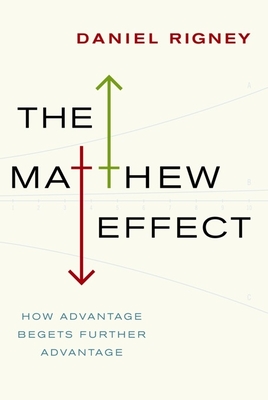
The old saying does often seem to hold true: the rich get richer while the poor get poorer, creating a widening gap between those who have more and those who have less. The sociologist Robert K. Merton called this phenomenon the Matthew effect, named after a passage in the gospel of Matthew. Yet the more closely we examine the sociological effects of this principle, the more complicated the idea becomes. Initial advantage doesn't always lead to further advantage, and disadvantage doesn't necessarily translate into failure. ...
Read More
The old saying does often seem to hold true: the rich get richer while the poor get poorer, creating a widening gap between those who have more and those who have less. The sociologist Robert K. Merton called this phenomenon the Matthew effect, named after a passage in the gospel of Matthew. Yet the more closely we examine the sociological effects of this principle, the more complicated the idea becomes. Initial advantage doesn't always lead to further advantage, and disadvantage doesn't necessarily translate into failure. Does this theory need to be revisited? Merton's arguments have significant implications for our conceptions of equality and justice, and they challenge our beliefs about culture, education, and public policy. His hypothesis has been examined across a variety of social arenas, including science, technology, politics, and schooling, to see if, in fact, advantage begets further advantage. Daniel Rigney is the first to evaluate Merton's theory of cumulative advantage extensively, considering both the conditions that uphold the Matthew effect and the circumstances that cause it to fail. He explores whether growing inequality is beyond human control or disparity is socially constructed and subject to change. Reexamining our core assumptions about society, Rigney causes us to rethink the sources of inequity.
Read Less
Add this copy of The Matthew Effect: How Advantage Begets Further to cart. $3.29, very good condition, Sold by Midtown Scholar Bookstore rated 5.0 out of 5 stars, ships from Harrisburg, PA, UNITED STATES, published 2010 by Columbia University Press.
Add this copy of The Matthew Effect: How Advantage Begets Further to cart. $3.60, good condition, Sold by ZBK Books rated 4.0 out of 5 stars, ships from Belleville, NJ, UNITED STATES, published 2010 by Columbia University Press.
Choose your shipping method in Checkout. Costs may vary based on destination.
Seller's Description:
Fast &-Good condition. It may show normal signs of use such as light writing highlighting or library markings but all pages are intact and the book is fully readable. A solid complete copy that's ready to enjoy.
Add this copy of The Matthew Effect: How Advantage Begets Further to cart. $4.39, good condition, Sold by Midtown Scholar Bookstore rated 5.0 out of 5 stars, ships from Harrisburg, PA, UNITED STATES, published 2010 by Columbia University Press.
Choose your shipping method in Checkout. Costs may vary based on destination.
Seller's Description:
Good-Bumped and creased book with tears to the extremities, but not affecting the text block, may have remainder mark or previous owner's name-GOOD Standard-sized.
Add this copy of The Matthew Effect: How Advantage Begets Further to cart. $5.00, good condition, Sold by HPB-Red rated 5.0 out of 5 stars, ships from Dallas, TX, UNITED STATES, published 2010 by Columbia University Press.
Choose your shipping method in Checkout. Costs may vary based on destination.
Seller's Description:
Good. Connecting readers with great books since 1972! Used textbooks may not include companion materials such as access codes, etc. May have some wear or writing/highlighting. We ship orders daily and Customer Service is our top priority!
Add this copy of The Matthew Effect: How Advantage Begets Further to cart. $10.41, good condition, Sold by SurplusTextSeller rated 5.0 out of 5 stars, ships from Columbia, MO, UNITED STATES, published 2010 by Columbia University Press.
Choose your shipping method in Checkout. Costs may vary based on destination.
Seller's Description:
Good. Ships in a BOX from Central Missouri! May not include working access code. Will not include dust jacket. Has used sticker(s) and some writing or highlighting. UPS shipping for most packages, (Priority Mail for AK/HI/APO/PO Boxes).
Add this copy of The Matthew Effect to cart. $20.00, good condition, Sold by Southampton Sag Harbor Books rated 5.0 out of 5 stars, ships from Southampton, NY, UNITED STATES, published 2010 by Columbia University Press.
Choose your shipping method in Checkout. Costs may vary based on destination.
Seller's Description:
Like New. First Edition, First Printing. Published by Columbia University Press, 2010. Octavo. Hardcover. Book is like new with light previous owner pencil underlining and margin notes. Dust jacket is like new.100% positive feedback. 30 day money back guarantee. NEXT DAY SHIPPING! Excellent customer service. Please email with any questions. All books packed carefully and ship with free delivery confirmation/tracking. All books come with free bookmarks. Ships from Sag Harbor, New York.