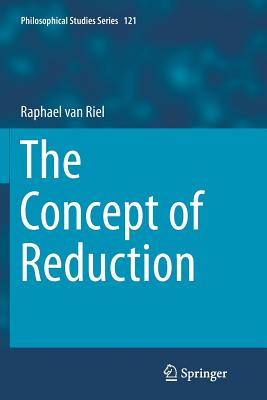
This volume investigates the notion of reduction. Building on the idea that philosophers employ the term 'reduction' to reconcile diversity and directionality with unity, without relying on elimination, the book offers a powerful explication of an "ontological", notion of reduction the extension of which is (primarily) formed by properties, kinds, individuals, or processes. It argues that related notions of reduction, such as theory-reduction and functional reduction, should be defined in terms of this explication. Thereby, ...
Read More
This volume investigates the notion of reduction. Building on the idea that philosophers employ the term 'reduction' to reconcile diversity and directionality with unity, without relying on elimination, the book offers a powerful explication of an "ontological", notion of reduction the extension of which is (primarily) formed by properties, kinds, individuals, or processes. It argues that related notions of reduction, such as theory-reduction and functional reduction, should be defined in terms of this explication. Thereby, the book offers a coherent framework, which sheds light on the history of the various reduction debates in the philosophy of science and in the philosophy of mind, and on related topics such as reduction and unification, the notion of a scientific level, and physicalism. The book takes its point of departure in the examination of a puzzle about reduction. To illustrate, the book takes as an example the reduction of water. If water reduces to H2O, then water is identical to H2O - thus we get unity. Unity does not come at the price of elimination - claiming that water reduces to H2O, we do not thereby claim that there is no water. But what about diversity and directionality? Intuitively, there should be a difference between water and H2O, such that we get diversity. This is required for there to be directionality: in a sense, if water reduces to H2O, then H2O is prior to, or more basic than water. At least, if water reduces to H2O, then H2O does not reduce to water. But how can this be, if water is identical to H2O? The book shows that the application of current models of reduction does not solve this puzzle, and proposes a new coherent definition, according to which unity is tied to identity, diversity is descriptive in nature, and directionality is the directionality of explanation.
Read Less
Add this copy of The Concept of Reduction to cart. $44.32, new condition, Sold by Educational Media Centre rated 4.0 out of 5 stars, ships from New Delhi, DELHI, INDIA, published 2016 by Springer.
Add this copy of The Concept of Reduction to cart. $45.07, new condition, Sold by Educational Media Centre rated 4.0 out of 5 stars, ships from New Delhi, DELHI, INDIA, published 2016 by Springer.
Add this copy of The Concept of Reduction to cart. $51.65, new condition, Sold by Ingram Customer Returns Center rated 5.0 out of 5 stars, ships from NV, USA, published 2016 by Springer.
Add this copy of The Concept of Reduction to cart. $55.00, new condition, Sold by Basi6 International rated 5.0 out of 5 stars, ships from Irving, TX, UNITED STATES, published 2016 by Springer.
Add this copy of The Concept of Reduction (Philosophical Studies Series, to cart. $80.10, good condition, Sold by Bonita rated 4.0 out of 5 stars, ships from Santa Clarita, CA, UNITED STATES, published 2016 by Springer.
Add this copy of The Concept of Reduction (Philosophical Studies Series, to cart. $30.00, like new condition, Sold by boredom books rated 3.0 out of 5 stars, ships from Portland, OR, UNITED STATES, published 2014 by Springer.