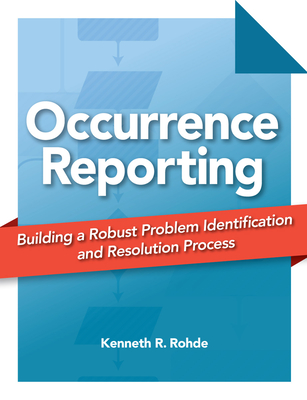
Occurrence Reporting: Building a Robust Problem Identification and Resolution Process Kenneth Rohde Enhance patient care through effective occurrence reporting You already capture the data. Now use it to make real improvements in your patient care. This new resource by performance improvement expert Kenneth R. Rohde provides practical techniques to help you better analyze your occurrence reporting process, use your data to gain superior insight into why errors occur at your organization, and make improvements ...
Read More
Occurrence Reporting: Building a Robust Problem Identification and Resolution Process Kenneth Rohde Enhance patient care through effective occurrence reporting You already capture the data. Now use it to make real improvements in your patient care. This new resource by performance improvement expert Kenneth R. Rohde provides practical techniques to help you better analyze your occurrence reporting process, use your data to gain superior insight into why errors occur at your organization, and make improvements that decrease adverse events and enhance patient care. Benefits: Refine and improve your existing occurrence reporting system using a proven six-step approach Arm yourself with the right data to become an effective change agent in your organization Develop an occurrence reporting process that decreases adverse events and enhances patient care Improve your report screening process Easily identify trends through detailed, efficient analysis methods Organize and prioritize your reports through effective coding Implement successful corrective actions through ongoing tracking and evaluation Table of Contents: Chapter 1: Rethinking the Occurrence Reporting Process Where Does Healthcare Go Wrong? Healthcare Is Not the Only Industry That Does Problem Identification and Resolution (PIR) Recommendations for an Ideal Process Chapter 2: The PIR Process Introducing the PIR Process Six Steps in the PIR Process Chapter 3: Reporting Importance of Managing Reporting Volume and Severity Must Dance Together Reporting Thresholds Tips for Normalization Internal vs. External Identification of Issues Two Simple Goals for Reporting Volume Tips for Improving Your Reporting Chapter 4: Screening Screening Is Really Just Prioritization Establishing Screening Criteria Reporting Severity Screening Quality Control Tips for Improving Your Screening Chapter 5: Analysis A Graded Approach to Problem Analysis Individual Analysis for High-Impact Problems and Moderate-Impact Problems Aggregated Analysis for Watch/Trend Problems Aggregated Analysis of Causes: The Big Payoff Five Simple Data Questions Trending and Aggregation Methods A Typical Analysis Session What Do Your Department Managers Really Want to Know? Chapter 6: Coding The Vital Process of Coding Code Based on Data Utilization A Practical Coding Structure Coding the Event vs. Coding the Causes Initial Event Codes Code Cleanup Troubleshooting Tips to Improve Coding Chapter 7: Causing Change: Implementing Corrective Actions Designing the Right Change Getting Stuff Done Dealing With External Commitments Tips to Improve Implementation Chapter 8: Tracking and Evaluation Tracking Actions Evaluation of Actions Evaluating the Effectiveness of the PIR Process Chapter 9: Taking Your PIR Process to the Next Level Looking Toward the Future Look at the 90 occurrence reporting tools included! Aviation Safety Reporting System incident report excerpt National Transportation Safety Board incident report excerpt FDA adverse event report sample IAEA initiation report sample CPSC incident report Quick guide to avoiding weaknesses: Build strengths in your PIR process Six steps of the PIR process Self-assessment questions to evaluate reporting, screening, analysis, coding, implementation, and tracking and evaluation Reporting stability Self-reporting Reporting by department Combine volume and severity to get the best picture Example: Calculating relative activities for use in normaliza
Read Less
Add this copy of Occurrence Reporting: Building a Robust Problem to cart. $43.95, very good condition, Sold by BookDrop rated 4.0 out of 5 stars, ships from Phoenix, AZ, UNITED STATES, published 2011 by Hcpro Inc.
Publisher:
Hcpro, a Division of Simplify Compliance
Published:
2011
Language:
English
Alibris ID:
18933349051
Shipping Options:
Standard Shipping: $4.99
Choose your shipping method in Checkout. Costs may vary based on destination.
Seller's Description:
Very good. Gently read. May have name of previous ownership or ex-library edition. Binding tight; spine straight and smooth with no creasing; covers clean and crisp. Minimal signs of handling or shelving. 100% GUARANTEE! Shipped with delivery confirmation if you're not satisfied with purchase please return item! Ships USPS Media Mail.
Add this copy of Occurrence Reporting: Building a Robust Problem to cart. $88.93, good condition, Sold by Bonita rated 4.0 out of 5 stars, ships from Santa Clarita, CA, UNITED STATES, published 2011 by Hcpro Inc.