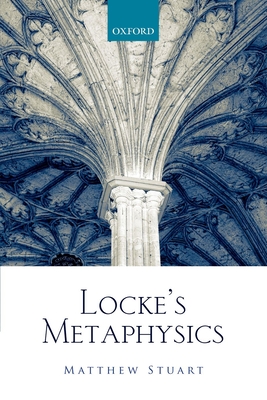
Though John Locke set out to write a book that would resolve questions about the origin and scope of human knowledge, his Essay Concerning Human Understanding is also a profound contribution to metaphysics, full of arguments about the fundamental features of bodies, the notions of essence and kind, the individuation of material objects, personal identity, the nature and scope of volition, freedom of action, freedom of will, and the relationship between matter and mind. Matthew Stuart examines a broad range of these ... Read More
Though John Locke set out to write a book that would resolve questions about the origin and scope of human knowledge, his Essay Concerning Human Understanding is also a profound contribution to metaphysics, full of arguments about the fundamental features of bodies, the notions of essence and kind, the individuation of material objects, personal identity, the nature and scope of volition, freedom of action, freedom of will, and the relationship between matter and mind. Matthew Stuart examines a broad range of these arguments, and explores the relationships between them. He offers fresh interpretations of such familiar material as the distinction between primary and secondary qualities, and Locke's account of personal identity; and he also takes us deeper into less familiar territory, including Locke's case against materialism and his philosophy of action. Locke's Metaphysics shows Locke to be a more consistent, systematic and interesting metaphysician than is generally appreciated. It defends him against charges of muddling the definition of 'quality', of waffling between two conceptions of secondary qualities, and of vacillating in his commitment to mechanism. It shows how his rejection of essentialism leads him to embrace relativism about identity, and that his relativism about identity is the key to defending his account of personal identity against several objections. Yet the picture of Locke that emerges is not always a familiar one. Stuart's account reveals that he is a philosopher who denies the existence of relations, who takes bodies to be colored only so long as we are looking at them, and who is not committed to mechanism. He shows that Locke takes persons to be three-dimensional beings whose pasts are 'gappy' rather than continuous. Finally, he shows that Locke is a volitionist who holds that we can will only our own thoughts and bodily motions, and not such episodes as lighting a candle or turning the pages of a book. Read Less
Add this copy of Locke's Metaphysics to cart. $73.99, new condition, Sold by Booksplease rated 4.0 out of 5 stars, ships from Southport, MERSEYSIDE, UNITED KINGDOM, published 2017 by Oxford University Press.
Add this copy of Locke's Metaphysics to cart. $75.00, very good condition, Sold by Koster's Collectible Books rated 5.0 out of 5 stars, ships from Farmingville, NY, UNITED STATES, published 2013 by Oxford University Press.
Choose your shipping method in Checkout. Costs may vary based on destination.
Seller's Description:
Very Good-in Very Good-dust jacket. 0199645116. Hardcover in dust jacket. Black cloth boards lightly bumped at edges and spine. Corners rubbed and bumped. Occasional light pencil to text. Illustrated dust jacket shows edge wear. One inch closed tear. Always carefully wrapped and shipped in cardboard boxes to protect your purchase.; 8vo 8"-9" tall; 542 pages.
Add this copy of Locke's Metaphysics to cart. $102.08, good condition, Sold by Bonita rated 4.0 out of 5 stars, ships from Santa Clarita, CA, UNITED STATES, published 2017 by Oxford University Press.
Add this copy of Locke's Metaphysics to cart. $127.44, good condition, Sold by Bonita rated 4.0 out of 5 stars, ships from Santa Clarita, CA, UNITED STATES, published 2013 by Oxford University Press.
Add this copy of Locke's Metaphysics to cart. $131.87, new condition, Sold by Just one more Chapter rated 4.0 out of 5 stars, ships from Miramar, FL, UNITED STATES, published 2017 by Oxford University Press.
Add this copy of Locke's Metaphysics to cart. $137.34, new condition, Sold by Bonita rated 4.0 out of 5 stars, ships from Santa Clarita, CA, UNITED STATES, published 2017 by Oxford University Press.