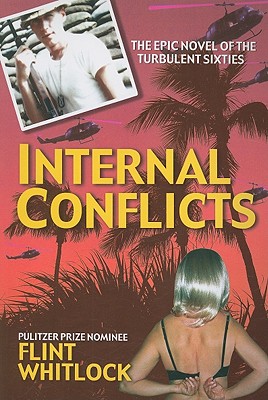
"What Good Is Fighting For People When The People
?Review Written by Bernie Weisz, Historian, Vietnam War Pembroke Pines, Florida, U.S.A. January 13, 2011 Title of Review:
"What Good Is Fighting For People When The People You Are Fighting For Hate Your Guts? And By the Way, Welcome to Vietnam!" Flint Whitlock has done come in with a superb historic lesson about many issues in "Internal Conflicts." On the surface, this is a novel about a young, Army officer who while joining the Army in an attempt to discover his manhood by way of wearing "army greens, sexual conquests and love," searches for the meaning of life in the tumultuous 1960's. Although Whitlock throws to the reader a novel of varied themes, i.e. eroticism, romance, sibling rivalry, mortality, murder, war, and peace, his protagonist, a Vietnam bound Officer named Peter, Luton, sums up his personal "Internal Conflict" best in this book with his following lament: "My mother is not really my mother, my brother is not really my brother, my father was not really my father, I am not who I always thought I was." The title chosen by Flintlock is appropriate, as Luton, an awkward, graceless youth matures into adulthood in the shadow of his older, athletically adroit brother Jack. Full of negative self poise and overly sensitive, Peter is forever plagued by self-recrimination, indecision and self doubt. As the reader will discover through what Whitlock deemed "The Incident," Luton's impulsive behavior precipitate negative repercussions that cause self doubt and insecurity that plague him nearly to the end of this story. Yet, the reader need to be forewarned: when it came time for Luton to step to the plate and prove his prowess and fortitude in the face of death, he smashed a grand slam home run. Unfortunately for Luton, his base clearing blast was in an unforgiving place that was not a John Wayne film, devoid of makeup, fake blood, flags and bugles. This was in Vietnam and in the watershed year of this conflict, where he was to ultimately find out that he was deceived by his drill instructors with the following admonition: "The more you sweat in peacetime, the less you bleed in wartime."
Regardless, the "internal conflicts" of Peter Luton continue. After a two week stay in Milwaukee, Luton flew to Vietnam, via San Francisco and the Philippines, a common passage during the war. However, an interesting tract was included by Whitlock, which speaks volumes, in terms of ambivalence: "Luton landed in San Francisco, was bussed across the bay bridge to Travis Air Force Base, near Oakland, where he spent the night at the Visiting Officers Quarters. early the next morning, Peter, along with twenty other officers, was loaded onto a 727 in which now he sat, along with ten dozen other worried, frightened, and confused soldiers, to continue their westward journey. A brief refueling stop in Hawaii, and then they were airborne again, flying in a wide arc over Pearl Harbor, where Peter looked downward could see the submerged hull of the U.S. S. Arizona, and he though sadly of the noble men still entombed within her. Now that had been a war-a war to embrace fervently, a war to get excited about. He wondered why he-or anyone else he knew-wasn't excited about going off to war." Anyone that has experienced the Vietnam ordeal will immediately identify. Luton landed at Bien Hoa Air Base and Whitlock wrote: "Even though it was two in the morning, the heat and humidity swamped Peter like a soaking wet electric blanket turned up high." The day was January 31, 1968, the first day of the Lunar New Year, as well as the infamous "Tet Offensive." As promised, I am not going to spoil the outcome, but this is where this book travels at the speed of light to it's earth shaking outcome. Several key events happen that influence the outcome of this book. Luton goes on an emergency bereavement leave following several months "In Country" after he is informed that his mother without warning drooped dead of a heart attack and through a chance of fate gets caught in the 1968 Democratic Convention riots. "Internal Conflicts" continues as he is both tear gassed and bashed in the head by Mayor Richard Daley's goons,and assailed a "baby killer" by the protesting, unruly crowds. Like most Vietnam Vets that became "adrenalin junkies," as he couldn't resist the call of Vietnam to return, where ironically he felt at home. Luton cried "What are they doing to our country?"
The major events in Vietnam were the meeting of Jack Luton with Captain Todd Gorman and Australian Army Captain Graham Birdsong, both of whom played vital roles in propelling the novel to its shattering, inevitable conclusion with an emotional impact that few readers will be able to ever forget! Gorman knocked America's role of world policeman and showed Luton, given a safe, air conditioned desk job, the realities of the war. Pulled to an evacuation hospital, Gorman showed Luton both KIA and WIA victims, some dismembered, some burned beyond recognition. While Luton sat behind a desk, Gorman explained that every promise and guarantee the Army made to him had been broken. Warning Luton, Gorman exhorted: "If the Army says we are winning this war, head for the bomb shelter. The generals don't want this war to end. It's their profession, their livelihood, their whole reason for being. If peace talks are ever held and the fighting stops, the generals will be out of work. They'll be stuck at the Pentagon, making chains out of paper clips." Luton also saw the false, inaccurate reporting of the Tet Offensive. A complete American route of the enemy, the men with the pens and microphones reported this as a U.S. military defeat, while in reality it was a shattering blow to the North Vietnamese and Viet Cong. The final internal conflict was when Luton met a "Digger"(A soldier in the Australian Army) named Captain Birdsong, who albeit inebriated, hit a sensitive nerve in Whitlock by questioning his manhood and calling him a coward. Birdsong sent Luton over the edge by telling him: You should be out in the boondocks with us, mate, mixing it up with Charlie, not pushing a pencil back at your cushy headquarters. Oh sure, you can say, "I'm in Vietnam, but you aren't really, are you? This is just like being in the States, isn't it, with a bit of shelling thrown in from time to time-just enough so that you don't have to feel guilty about collecting your hazardous pay duty. You and your fellow REMF's are more than willing to take the credit and the glory and the medals that will come your way for being in a war zone without actually taking part in the war itself. You're content to stand on the fringe of the battlefield, handing food and ammunition to those of us who are doing the real fighting, just as long as you don't get any of the mud or blood on you, You truly do believe in stopping communism-as long as it's someone else who has to do the actual stopping. Am I right?" I promise what happens next will never leave you and will be read over and over again. If you read one historical novel about the Vietnam War, make it "Internal Conflicts."?