Powerful countries like the United States regularly employ economic sanctions as a tool for promoting their foreign policy interests. Yet this foreign policy tool has an uninspiring track record of success, with economic sanctions achieving their goals less than a third of the time they are imposed. The costs of these failed sanctions policies can be significant for the states that impose them, their targets, and the other countries they affect. Explaining economic sanctions' high failure rate therefore constitutes a vital ...
Read More
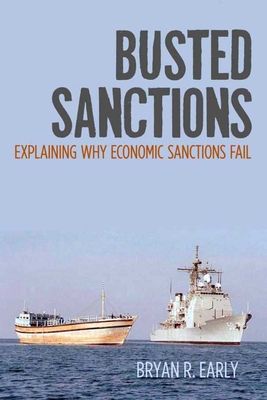
Powerful countries like the United States regularly employ economic sanctions as a tool for promoting their foreign policy interests. Yet this foreign policy tool has an uninspiring track record of success, with economic sanctions achieving their goals less than a third of the time they are imposed. The costs of these failed sanctions policies can be significant for the states that impose them, their targets, and the other countries they affect. Explaining economic sanctions' high failure rate therefore constitutes a vital endeavor for academics and policy-makers alike. Busted Sanctions seeks to provide this explanation, and reveals that the primary cause of this failure is third-party spoilers, or sanctions busters, who undercut sanctioning efforts by providing their targets with extensive foreign aid or sanctions-busting trade. In quantitatively and qualitatively analyzing over 60 years of U.S. economic sanctions, Bryan Early reveals that both types of third-party sanctions busters have played a major role in undermining U.S. economic sanctions. Surprisingly, his analysis also reveals that the United States' closest allies are often its sanctions' worst enemies. The book offers the first comprehensive explanation for why different types of sanctions busting occur and reveals the devastating effects it has on economic sanctions' chances of success.
Read Less
Add this copy of Busted Sanctions: Explaining Why Economic Sanctions to cart. $25.83, new condition, Sold by GreatBookPrices rated 4.0 out of 5 stars, ships from Columbia, MD, UNITED STATES, published 2015 by Stanford University Press.
Choose your shipping method in Checkout. Costs may vary based on destination.
Seller's Description:
New. Trade paperback (US). Glued binding. 288 p. Contains: Unspecified. In Stock. 100% Money Back Guarantee. Brand New, Perfect Condition, allow 4-14 business days for standard shipping. To Alaska, Hawaii, U.S. protectorate, P.O. box, and APO/FPO addresses allow 4-28 business days for Standard shipping. No expedited shipping. All orders placed with expedited shipping will be cancelled. Over 3, 000, 000 happy customers.
Add this copy of Busted Sanctions: Explaining Why Economic Sanctions to cart. $25.84, new condition, Sold by Ingram Customer Returns Center rated 5.0 out of 5 stars, ships from NV, USA, published 2015 by Stanford University Press.
Add this copy of Busted Sanctions: Explaining Why Economic Sanctions to cart. $46.47, new condition, Sold by Booksplease rated 4.0 out of 5 stars, ships from Southport, MERSEYSIDE, UNITED KINGDOM, published 2015 by Stanford University Press.
Add this copy of Busted Sanctions; Explaining Why Economic Sanctions to cart. $50.00, very good condition, Sold by Ground Zero Books, Ltd. rated 5.0 out of 5 stars, ships from Silver Spring, MD, UNITED STATES, published 2015 by Stanford University Press.
Edition:
Presumed First Paperback Edition, First printing
Publisher:
Stanford University Press
Published:
2015
Language:
English
Alibris ID:
15218229908
Shipping Options:
Standard Shipping: $4.99
Trackable Expedited: $9.99
Choose your shipping method in Checkout. Costs may vary based on destination.
Seller's Description:
Very good. x, [2], 275, [1] pages. Tables. Figures. Notes. References. Index. Bryan R. Early is an Associate Professor in the Political Science Department, the Director of the Center for Policy Research (CPR), and the founding Director of the Project on International Security, Commerce, and Economic Statecraft (PISCES). He researches topics related to foreign policy, international security, and political violence and is an expert on economic sanctions, strategic trade controls, and the proliferation of nuclear and aerospace technology. His work has appeared in journals such as the British Journal of Political Science, International Studies Quarterly, the Journal of Conflict Resolution, Foreign Policy Analysis, and the Nonproliferation Review. His book Busted Sanctions: Explaining Why Economic Sanctions Fail offers the first comprehensive explanation of the causes and consequences of sanctions busting. Early graduated with his Ph.D. in Political Science from The University of Georgia in 2009. Powerful countries like the United States regularly employ economic sanctions as a tool. Yet economic sanctions achieving their goals less than a third of the time. Explaining economic sanctions' high failure rate therefore constitutes a vital endeavor for academics and policy-makers alike. Busted Sanctions reveals that the primary cause of this failure is third-party spoilers, or sanctions busters, who undercut sanctioning efforts by providing their targets with foreign aid or sanctions-busting trade. In quantitatively and qualitatively analyzing over 60 years of U.S. economic sanctions, Bryan Early reveals that both types of third-party sanctions busters have played a major role in undermining U.S. economic sanctions. His analysis also reveals that the United States' closest allies are often its sanctions' worst enemies. The book offers the first comprehensive explanation for why different types of sanctions busting occur and reveals the effects it has on economic sanctions' chances of success.